
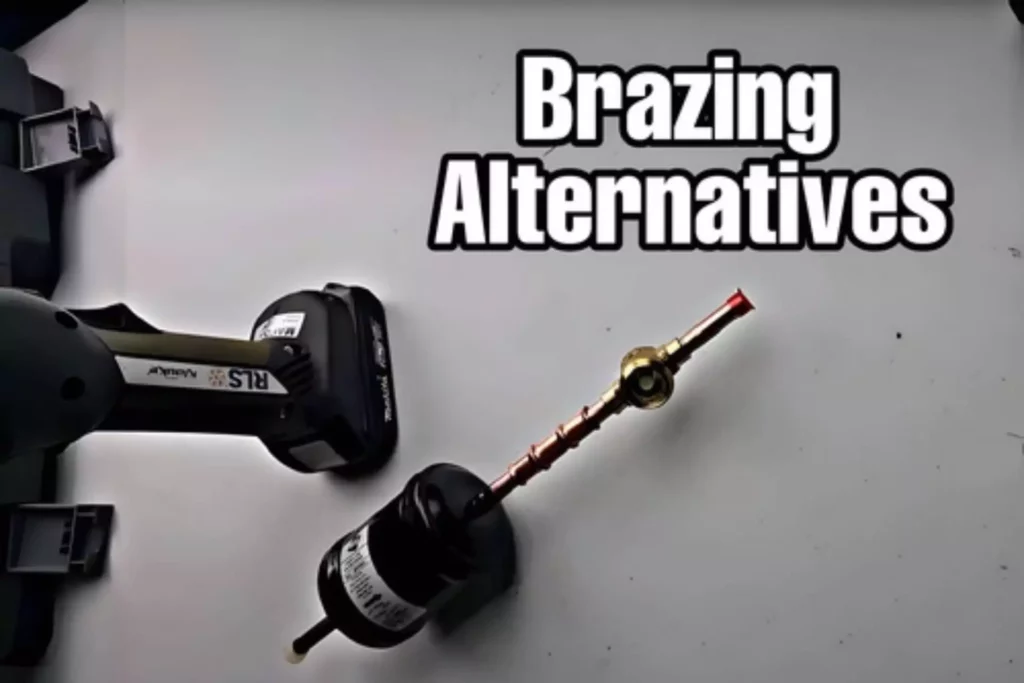
Brazing Alternatives for the Progressive HVACR Technician
If you make mention to the HVAC/R hardcorest there might be alternatives to brazing (that work), you might get one of those mad face emojis thrown up at your comment!
The fact is, brazing is a solid connection that lasts for many years and is a fundamental skill that all HVAC/R professionals need to carry out their work.
One thing I’m not convinced of is the “brazing is an art” comment.
Art is a unique expression, and brazing is “supposed” to be a repeatable process with the same result over and over.
Okay, some braze joints look like they should be in an art gallery, but not for a good reason.
There are some in the social media world that tend to think I don’t like brazing or perhaps don’t believe in it.
That can’t be further from the truth.
I just enjoy looking at and experimenting with new technology at any level to boost my knowledge in the HVAC/R trade.
I have been impressed with the SolderWeld products lately and how well the rods flow.
Why Not Brazing?
There are some good reasons that brazing alternatives have been developed and will continue be.
I remember one facility I worked at many years ago required a 4-hour fire watch after the torch went out.
I understand why the building was constructed with wooden beams.
Although I understand why, that long of a fire watch is very time-consuming and not practical for many busy techs in most situations.
Others reasons why brazing alternatives have been developed also have to do with fire.
Fire is dangerous; fire is expensive, and “hot work” fires happen more often than you think.
Here is a link to a PDF with some more info on hot work fires.
You may now understand why more and more buildings are tightening rules around torch lighting.
There are health issues that surround brazing, especially indoors with little ventilation.
Brazing/ welding fumes in the air contain many substances that we shouldn’t breathe in.
I used to work in many data centers; these rooms are typically sealed to keep the environment at a constant temperature and humidity with specialized equipment.
If I were brazing in these rooms, the fumes would linger for hours, leaving myself, the IT staff, and other occupants to breathe.
Check out this article from the University of Alabama on brazing and health.
Some environments, medical, pharmaceutical, or other industries may not allow brazing due to the surrounding environment.
Alternatives
When I discuss brazing alternatives, I can only talk about the products I have checked out and put my hands on personally; I will go through a few of these.
Pro Fit Quick Connect
The RectorSeal PRO-Fit Quick Connect is the first one we’ll tackle here.
My experience at the time of writing this article is only on a bench.
I have not field installed one yet.
However, I have had many peers online talk positively about them and used them in situations such as repairs in attic or crawl spaces where it may be difficult to get a set or torches into.
Like all pipe fitting procedures, the pipe must be thoroughly cleaned before use.
The pipe must also be marked with a depth gauge to ensure the “push” fitting is inserted to the correct depth on the pipe.
I can see an advantage to using the PRO-Fit in scenarios where a quick repair is needed.
Where a torch can’t be lit or if the time to pull a fire permit, collect torches, nitrogen, and all other fire mitigation gear would be put the environment to be cooled or heated in jeopardy such as a server room, lab, or another critical environment.
AC Smart Seal External
The first time I used AC Smart Seal External in a real-life application was a few years back inside a server room or data center, as some may call it.
There was a rub-through on a capillary line on a water regulator valve, and the system lost its charge.
This was a perfect scenario to try this product.
Instead of lugging torches up to the room, I applied the putty-like substance around the leak site.
It held under a pressure test and evacuation.
It also held charge for an entire year until the whole valve was replaced.
I avoided pulling fire permits and brazing in a sealed room with little to no ventilation and breathing in fumes created by the brazing process.
Fixquick
FixQuick is an interesting product that I have only bench tested, but it held approximately 400 PSI.
It’s a two-part system that consists of a liquid and a powder accelerant.
I believe it would be a great alternative to brazing in certain situations.
One that comes to mind is, repairing a pinhole evaporator leak that has succumbed to corrosion and would be in jeopardy of further damage if a flame were to come into contact with it.
Rapid Locking System
For repair and installation projects, Rapid Locking System definitely has the versatility to conquer both.
With a large lineup of fittings, valves, filter driers, and sight glass assemblies, most projects can be completed with their press tool and jaws.
Personally, I haven’t completed a full install project but have talked to many that have with positive results.
I was mainly a service tech with my former company until I launched McCreadie HVAC.
I have completed many repairs with RLS, also replaced filter driers, and completed a couple of unfinished install projects by others.
I personally enjoyed every minute of prepping, and pressing with RLS.
It’s definitely a technology that one must get used to but, more importantly, experiment with it to understand it better.
RLS does extensive training with their product, and I suggest you reach out to them if you are interested in more information.
Conclusion
These are just a few brazing alternatives out there.
But I believe this is just scratching the surface.
The technology will advance, improve, and become more available once trust and traction begin to dig its heels.
My prediction, on a grand scale, less and less torches will be lit over the coming years.
My advice, stay up to date on new technology as it hits the market. Knowledge is power!