
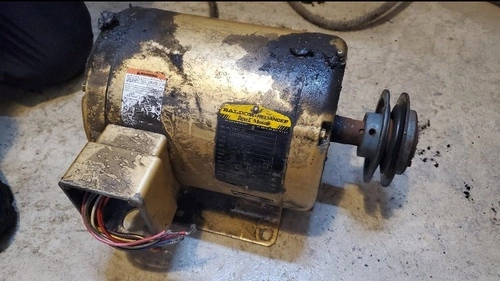
How HVAC Motors Work!
As an HVAC technician, you come into contact with many different electric motors in your day-to-day operations.
Likely even working with motors every single day, ranging in size from small domestic appliance motors up to large motors operating industrial applications.
In your typical residential, commercial, or industrial HVAC systems, you’ll come across fan, compressor, and pump motors.

Motors power blowers to move air, drive compressors to compress refrigerants, and power the pumps that move water and other liquids.
The motors driving fans often require a lower starting torque, while compressor and pump motors require a high starting torque.
Understanding the basics of the motors you work with every day can make your job a breeze.
Know what motor is required for the job when installing, repairing, and maintaining HVAC systems and select the correct motor when designing new systems or recommending equipment.
The following is a look at six common HVAC motors and how they work.
Permanent Split Capacitors Motors (PSC Motors)
Permanent split capacitor motors are a single-phase AC induction motor most often found in small to medium HVAC systems powering fans, pumps, and compressors.
The PSC motor is the most common motor in HVAC applications, often considered the workhorse of the HVAC industry.
Their design includes fewer wearable components, allowing for a cost-effective, reliable, and versatile operation.
PSC motors run on two windings, the main winding and the auxiliary or start winding.
Both the main and the start winding are permanently engaged in the motor’s circuit.
A run capacitor, which is connected in series with the start winding, gives the motor a small boost in torque at start-up and while running (when needed).
These motors do not have the centrifugal switch that disengages the start winding from the main winding.
Since both of a PSC motor’s windings are permanently engaged and the start winding is out of phase from the main winding, the motor operates as a two-phase motor.
Allowing for a more smooth and efficient operation and a higher torque than what is available from your typical single-phase motor.
On the downside, PSC motors only convert about 65% of the input power into mechanical work.
Due to evolving government environmental regulations, the PSC motor will likely move out of popularity over the next 20 years.
Electronically Communated Motors(ECM)
Electronically commutated motors are small, brushless DC motors with fractional horsepower ratings and variable speed operation.
A built-in inverter allows them to run on AC power; the inverter converts AC power to DC power for the motor’s use.
These motors feature a microprocessor (computer) that controls commutation, explaining the absence of the carbon brushes.
This computer also controls torque, allowing the ECM to maintain a consistent speed under varying load conditions and provides a wider range of air speed control.
While electronically commutated motors are more expensive to purchase, they make up for it with their easy speed control, high energy efficiency, quiet operation, and compact design.
ECMs are typically 40% more efficient than PSC motors.
Split phase – The split phase motor with no capacitors is similar to the PSC motor in that they both feature the two windings: the main winding and the auxiliary/start winding.
However, the split phase motor has the centrifugal switch, which disengages the start winding once the motor has reached 70-80% of its total speed.
The start winding is only engaged at start-up to provide a little additional torque.
In general, these split phase motors produce less torque and don’t provide great efficiency but do provide decent speed regulation when under varying loads.
You’ll typically find these motors in low torque applications, paired with fans and blowers.
Capacitor Start – Induction Run Motors (CSIR Motors)
Capacitor start – induction run motors are split phase motors with the addition of a start capacitor to the start winding circuit.
The start capacitor helps by boosting torque up to 4x at start-up, allowing the motor to drive high-inertia loads.
CSIR motors are most often found powering compressors and pumps, loads that need a high starting torque.
Unfortunately, since the start winding is disengaged after start-up and there is no run capacitor, CSIR motors have relatively low efficiency.
Capacitor Start – Capacitor Run Motors (CSCR Motors)
Capacitor start – capacitor run motors a similar to CSIR motors with the addition of a run capacitor to the main winding circuit.
The run capacitor helps to smooth power and provides additional torque during operation.
Due to the addition of the second capacitor, these motors are typically more expensive than their CSIR counterpart.
Even still, CSCR motors are most commonly found in industrial applications above 2 HP that require higher torque at start up and while running.
The run capacitor also makes this motor run at a higher efficiency.
Shaded Pole Motors
Shaded pole motors have the simplest design and lowest cost of the single-phase AC induction motors.
They have a single main winding and shading coil placed over a portion of the main winding creating an imbalance of magnetic forces.
This imbalance creates a rotating magnetic field, providing enough torque to allow the motor to self-start.
While shaded pole motors are both simple and cheap, they are also low-torque, inefficient, and noisy to operate.
As such, you typically only find them driving small fans in refrigerators and freezers.
Check out this podcast discussing the operation of a few motors used in the HVAC industry.
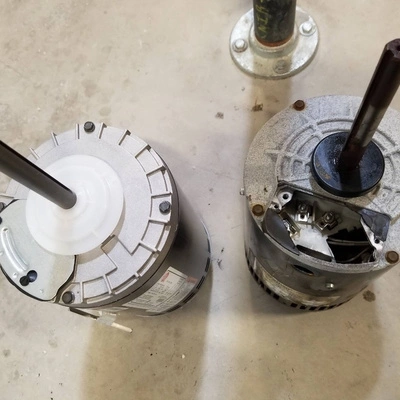
Summary
Design, efficiency, reliability, capability, and cost are all factors to consider when selecting the correct motor for your HVAC application.
Each motor has its strengths and limitations that make it either fit perfectly or fail catastrophically.
As an HVAC technician working with many motors every single day, understanding how each motor type works helps you make the right motor selection, no matter the job.