
The Science of AC Evacuation and On-Site Pull Down
The science of how we pull an evacuation on air conditioning and refrigeration systems has changed over the years.
Back in the day, technicians would purge refrigerant through the system to remove air, moisture, and other contaminants.
The introduction of POE oil has definitely changed the dynamic of this, as POE is hygroscopic, meaning it absorbs moisture from the air.
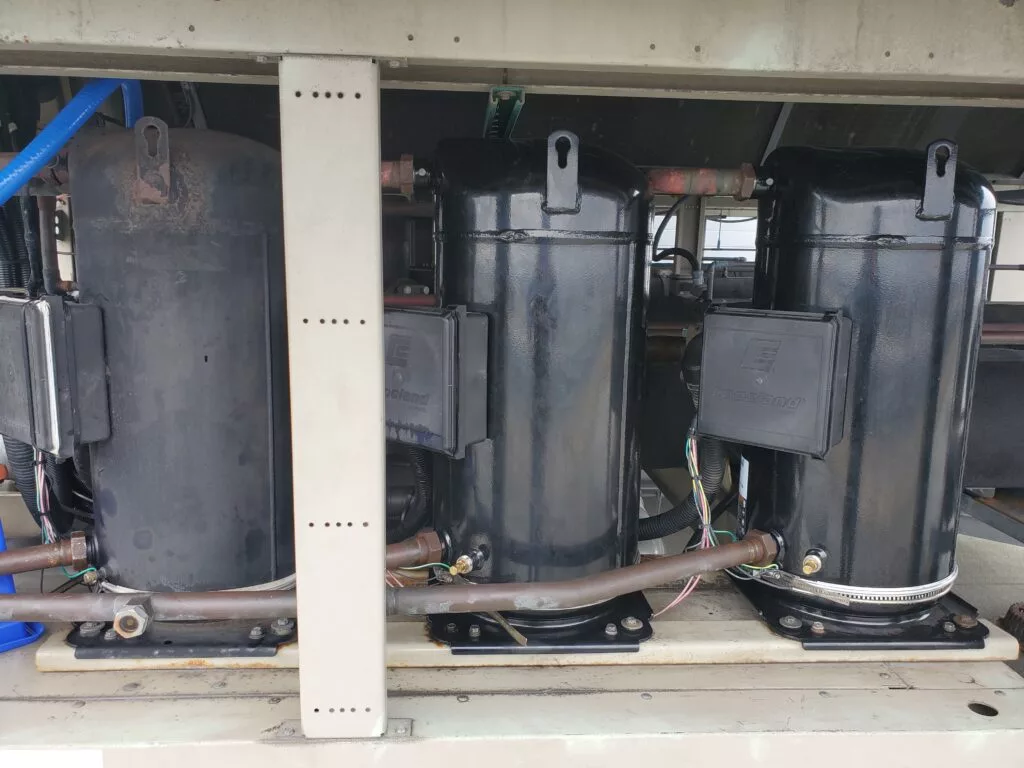
As it pertains to this article, I would like to focus on a particular job that was completed on a compressor trio (3 compressors piped in parallel to make up one circuit) on a McQuay air-cooled chiller.
The Job
The system had a failed compressor.
The compressor was replaced on the R22 system, which contained a mixture of mineral oil and POE oil.
The POE oil was introduced from a previous compressor change, as the new compressor from the previous and the new one in the present were both shipped with POE.
After the change, a pressure test was performed with nitrogen. The test held up over a 24-hour period.
At this point, an evacuation must be performed to remove air, moisture, and other system contaminants.
Many technicians use a manifold gauge to pull a vacuum on systems, but this can take longer as a manifold gauge has more potential leak points and restrictions; the 1/4″ charging hose allows provides restriction.
The Set Up
We can eliminate these restrictions from our setups by employing large-diameter hoses, removing Schrader cores and eliminating manifold gauges.
Many technicians I speak to get confused about how this setup works, “how do I put the cores back in?” is sometimes the question.
Using a core removal tool will allow techs to remove cores and re-install them when needed.
The core removal tool is a complete assembly that includes a core remover stem, a ball valve, and sometimes an auxiliary tee.
The ball valve allows you to isolate the system from the pump.
This has many advantages, like allowing you to perform a decay or rise test and removing or installing cores under pressure.
Check Out The Video Of A Schrader Core Removal Tool In Action
A surefire way to eliminate a manifold is to run vacuum-rated hoses from the system to the pump.
Many vacuum pumps are manufactured with several ports built into them and usually in different sizes as well.
Vacuum-rated hoses range in size, but most common are 3/8″, 1/2″, and Accutools has developed the TruBlu hose, which is 3/4″ in diameter.
You will need to use a micron gauge placed somewhere on the system side, not on the pump side, to monitor evacuation performance.
It is advised to keep the gauge up right to avoid any system contaminants from entering.
Check Out The Video Of The TruBlu Hose Racing A 1/4′ Hose To 500 Microns
The Steps
After the pressure test is complete…
✅ Note: it is vital to ensure your vacuum pump oil is fresh and free of contaminants.
A simple oil change can remedy this.
Also, it is advised to periodically perform an ultimate vacuum test on your pump prior to evacuation.
This is done by placing your micron gauge directly onto the pump itself.
Turn on the pump and ensure the micron reading reaches the nameplate ultimate vacuum of the pump.
- Add core removal assemblies to the system and remove the cores.
- Attach large diameter hoses to the core removal assemblies and run them to the vacuum pump.
- Place a micron gauge on the system side, not the pump side, to monitor evacuation performance.
- Start the pump and open up the core remover ball valves.
- Once final evacuation is complete, 500 microns or below, although some industry experts are advising that even lower is required. Close off the ball valves on the core tools and monitor a rise or decay in the pressure on the micron gauge. A fast, sharp rise may indicate a leak in the system, and a slow, gradual rise that flattens may indicate further evacuation must be performed as contaminants still exist.
Once the rise test is complete, we must add the refrigerant charge either from a tank or by opening up system service valves.
As the refrigerant is added to slight positive pressure, it is advised to remove the micron gauge, re-install Schrader cores, and take down the evacuation setup.
Then add the remaining charge to the system.
Job Site Evacuation
The steps above are generalized and don’t always reflect job site conditions.
Let’s talk about the compressor job from above.
The same tactics were employed as previously stated, but after a 20 hour evacuation, the system was just under 1000 microns.
Keep in mind that the pump ran overnight with temperatures below freezing.
An evacuation can struggle in colder temperatures as moisture can freeze within a system.
Small ice droplets can form and slow down the process.
Sublimation, a solid to a gas, will take place under these conditions but can reduce evacuation times, especially in colder ambient conditions.
I performed a sweep with nitrogen (purging the system with nitrogen), changed the vacuum pump oil, and turned on both the receiver and evaporator bundle heaters.
The heaters are used in extreme cold temperatures to keep system pressures up.
The vacuum pump was restarted, and the system was brought down to 2000 microns, and two more nitrogen sweeps were performed.
The heaters will help to raise system internal temperatures, the new oil will grab more contaminants, and the nitrogen will potentially melt formed ice droplets as it passes by and allow them to vaporize more easily during evacuation pull down.
The pump ran for another 48 hours, and on arrival at the site, the system had achieved 335 microns.
Check Out The Video From The Job Above, Which Explains In Detail The Outlined Steps
Summary
Some systems require a little more attention, especially larger machines that have been around for a while.
Smaller, newer systems shouldn’t have any issues pulling down as long as the system is tightly sealed.
Implementation of large-diameter hoses, removing restrictions and potential leak points will ensure your evacuation is efficient as possible.
Triple sweeps with nitrogen may help in some cases, but I find it’s not usually needed.
Removing your micron gauge at a slight positive pressure while charging will ensure it doesn’t suffer any damage.
Check out the link to my YouTube channel for more tips, tricks, and troubleshooting videos, and check out The HVAC Know It All podcast here or on your favorite podcast app.