
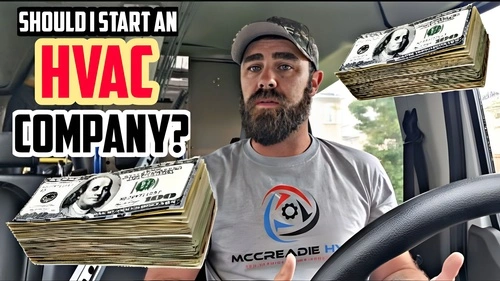
Should I Start My Own HVACR Business?
A large percentage of individuals that enter the HVAC and Refrigeration trade dream of one day becoming their own boss.
Rightfully so, as business ownership can bring many freedoms and perks and not just financial ones, it can also come with many hardships as well.
It seems the struggle for most that want to become their own boss is they are unsure of when to pull the trigger.
I’m hoping my experience in the decision-making process, with recently starting McCreadie HVAC and Refrigeration Services can help with this life-changing step.
In my experience, most venture out on their own in their late 20’s or early 30s, I did this at 43.
I wonder, in retrospect, why not sooner, but perhaps I wasn’t ready.
In this article, we will cover some major factors that go into the decision-making process.
Technical Experience
Let’s be blunt, if you haven’t built up enough technical experience, it’s not the time.
Your customers will want high-end service at any given moment.
You don’t need to know everything, but I do recommend you have a strong base knowledge of electrical, the refrigeration cycle, gas heating at a minimum, and good install practice experience.
I will admit, my sheet metal skills are subpar compared to many and that is something I’ve had to learn on my own and with help from people like Craig Migliaccio.
🔊 You can listen to our podcast conversation here on basic sheet metal skills.
Like any other industry, the lack of basic knowledge in the HVAC and Refrigeration industry can break you as a technician and definitely as a business owner.
Communication Skills
If you’re currently employed and looking to make your way into business ownership one day.
Start working on soft communication skills with everyone around you, Not Just The Customer!
You will need to communicate through email, text, and phone calls with vendors, salespeople, and even your competitors.
If you can’t communicate in an intelligent respectful manner, don’t worry about business ownership.
I have yet to meet someone that enjoys dealing with a know it all ass hat.
A good way to think about communication is this: If you want to maintain a good standing, long-term relationship with the professionals around you, your soft skills must be on point.
You must learn how people think and react and always be prepared to think on your feet in many situations.
This is why I’m against sales scripts. They are robotic and don’t allow the individual to think freely and on their toes.
I recorded a short podcast on this topic, again, this is only my opinion, but it’s based on my experience of 25 years in the trade.
It’s also best to keep your emotions in check when communicating in business.
If you get an email that sends you over the edge for example, don’t reply right away.
Step back and take a breather and communicate later once you have had a chance to process what it was that got you hot and bothered.
But, if something needs to be said say it, don’t sugarcoat it.
Sugar coating a message can leave the person on the other end confused about the meaning of what you’re trying to relay.
That said, it must be done respectfully and in a well-thought-out manner.
Resources
Resources can come in many forms, cash, tools, contacts, etc.
If you start with nothing, the struggle will be real.
I would definitely recommend building a base of resources.
Build up your tool collection overtime, so that when you’re ready to hit the road on your own you have quality, dependable weapons of choice to execute on your job sites.
Start gathering connections on places like LinkedIn and other social media sites.
It’s important to present yourself as a true professional on these platforms and not fall victim to trolling or negative behavior.
It’s also important to have some savings built up, new business ownership doesn’t always start out with a bang.
It’s a slow-moving process to build a customer base that is loyal and keeps coming back but more importantly pays the bills on time.
Let’s throw in a vehicle too, you can’t service or install without a set of wheels.
You’ll need to decide what you can afford in the beginning, but also, you’ll need something that is dependable and that will start every morning.
Remember that a well-wrapped vehicle can give your company an extra boost in the brand awareness category.
When I worked for my former company, I used to get flagged down from time to time by potential clients that needed work done.
Back then, I would tell them to call the office, now if that happens, I am able to sell myself as their go-to for whatever it is they flagged me down for in the first place.
A good wrap costs money, and it’s something you’ll need to budget for.
Business Sense
There are lots of great technicians and installers out there that can do their job well but can they do business well?
When getting into business for yourself, you’ll have to get on your negotiating hat, you’ll need to have an array of options for your customers, and you’ll have to price correctly based on many factors.
You’ll need to have help with finances, and back end stuff that the average tech working at another shop rarely has to do.
A good bookkeeper and CRM software is a good place to start and will help keep you on track.
I’m currently using Jobber as my CRM and hired a local bookkeeper as well.
Remember, the business can’t be personal, if you are rejected move on and don’t get down on yourself.
Just recently, I learned a lesson…
I went out and quoted on a residential installation and was not awarded the job.
I asked politely why.
I was told my pricing was fine but the other company had offered to relocate their thermostat and run the electrical.
At the time of my visit, the potential client had mentioned they would have their electrician complete that work so I didn’t include it.
From now on, if I have the ability to include it, I will have it as an option on my quote.
Lesson Learned!
Family Life
A huge factor before deciding is gauging the situation at home.
Are you single?
If you are, this could be the best time to start.
With no partner or dependents, you can spend as much time as needed to grow your business.
If perhaps you’re married with children, the stress of a new start-up and potentially being out for long hours can be hard for your family to accept in many situations.
It’s best to sit down and have a family meeting; that way, you can get a better understanding of how it may affect their lives.
Conclusion
HVAC/R business ownership is rewarding but not for the faint of heart.
A combination of skills and resources is needed to succeed.
Some people will collect these along the way and then pull the trigger, some on the other hand, will jump head-first into business ownership with a lack of these required skills and knowledge.
It’s your call, but I do believe that it’s best to prepare and plan before tackling the unknown.
If you’ve read till the end, you’re definitely a strong candidate to become your own boss one day, and I wish you the best of luck in whatever path you choose.
The good news is, I have enjoyed business ownership so far.
Being your own boss is really something special, and I believe everyone should get a chance to experience it.
🔊 Listen to this episode of the HVAC Know It All Podcast discussing HVAC/R business ownership.