
HVAC Air Balancing Procedure
Air balancing is an important step in HVAC commissioning.
Every forced air system should be balanced upon initial startup, and some engineers or city officials may demand it before final approval.
However, in my personal experience, air balancing is only requested when there is a noticeable issue with system performance, usually warm or cold bedrooms, or a perceived lack of airflow.
Whatever the reason, air balancing, done correctly, can alleviate these issues and help ensure the equipment is operating as efficiently as possible.
Balancing can be done in several ways, but the following basic steps are common to most methods.
1. Ensure You Have Proper Documentation
Before a system can be balanced, the technician should have any relevant documentation available to study and refer to while balancing.
This includes, but is not limited to, duct design calculations, duct layout, equipment specs, and control documentation.
If these aren’t available, then a sketch of the duct system should be made, as well as a recording of any nameplate data on the air handler.
Make a chart to track the airflows of each inlet and outlet, noting design airflows and leaving room to record actual airflows for comparison.
2. Confirm The System is Running at Design Conditions.
Once the system is started up, ensure it’s running as close to design parameters as possible.
Check to make sure all volume and splitter dampers are open.
Make sure the correct fan speed is engaged.
Take a static pressure reading or duct traverse to ensure CFM and pressure are within design limits.
Ensure delta-T is within the acceptable range.
Make sure any required accessories are in place, such as a filter.
3. Record Airflows at Each Supply Outlet.
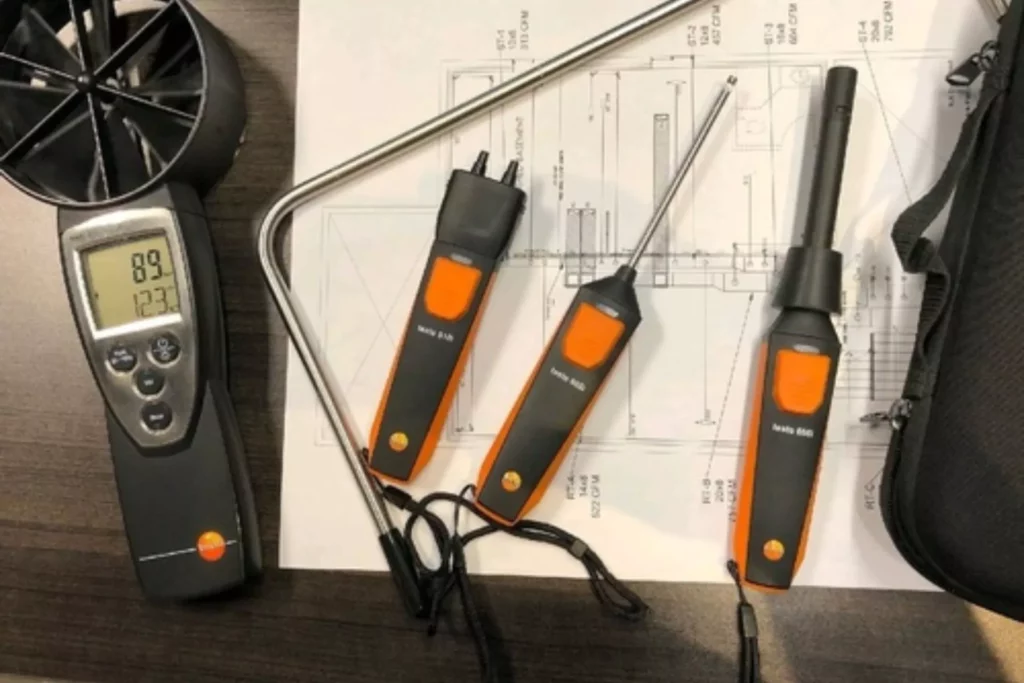
Using an airflow measuring tool, measure the airflow at each outlet and inlet and record them.
Make sure to account for the grille factors (AK) of each grille and register in the system.
For residential outlets, such as a 4×10 floor register, a vane anemometer is best.
For commercial diffusers, such as a 24×24 cone diffuser, a flow hood may have to be used.
Look up the manufacturer’s engineering data for AK factors.
4. Adjust Brand Dampers as Neccessary.
Compare the design airflows to the measured airflow.
Using the balancing dampers installed in each branch outlet, damper down the outlets with the highest airflow until they are within 10% of the design.
This may require some trial and error to find the right damper position.
5. Repeat Steps 3 and 4 Until All Outlet Airflows are Within 10% of the Design.
Once the airflows are set, ensure all dampers are secure.
Make one last measurement at each outlet to record a final CFM value.
This may mean measuring each outlet multiple times.
Final Thoughts
Return air inlets can be balanced the same way as above, but only if they are equipped with balancing dampers.
In Ontario, the current trend is to use stud and joist spaces as return air paths.
They usually have no dampers installed and there’s no guarantee that the openings in the framing will be cut to an adequate size.
In these cases, not much can be done to balance the return side.
For more information on system balancing procedures and methods, I highly recommend picking up a copy of ACCA Manual B Balancing and Testing Air and Hydronic Systems.
It’s an invaluable tool for any tech looking to learn more about balancing methodology.