
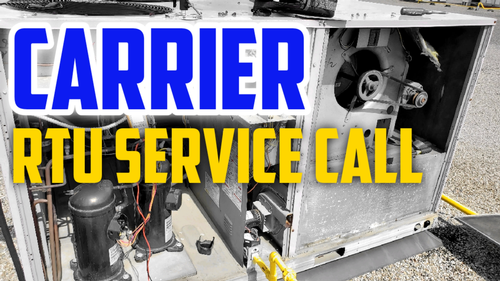
It was a warm August day, myself and my co-worker were digging into some PM work.
We found one of the Carrier RTUs without power and the breaker tripped.
I returned a couple of days later to unravel the mystery.
First step was to shut down the RTU from the local disconnect and reset the main breaker, after the reset, the breaker stayed on and didn’t trip.
This told me the problem didn’t lie in between the breaker and local disconnect, it was hidden in the package unit.
A visual inspection didn’t reveal anything at first and none of the main loads had any ground faults.
Before applying the main power to the unit I removed the R wire from the control circuit, this will stop any operation of fans, compressors, etc., and allow me to check for power in the primary and secondary locations without anything starting up.
You may crucify me for this but I did the bump, the contactor bump that is.
But by doing so, it revealed something important that led me in the right direction.
🎥 This video includes the troubleshooting steps taken to reveal the problem
Now, this set up is definitely interesting with a primary voltage of 575V for the compressors and 480V for the fans. The issue of higher voltage, as seen in the video, may have at some point damaged the motors that were being powered. To rectify the issue, the transformer that suffered damage was replaced.
🎥 In this video, watch as the transformer is replaced to rectify the issue
After the repair, I looked closer into how Carrier was generating the 480V using the 480V/240V to 240V/120V transformers.
My reference point was at the 460V to 24V control transformer.
Prior to the repair, the primary side of the transformer was receiving 347V (one leg of a 575V circuit) on one leg and 290V on the other, this generated a voltage of 560V across the transformer.
The 290V was fed from the transformer assembly in the condenser section.
After the repair, the 290V feed had been reduced to 245V, which translated to 489V across the primary side of the transformer.
So essentially, they are generating the required 480V by providing one leg of the primary voltage and one leg from the secondary side of the transformer assembly at the condenser section.
Learn More with HVAC Know It All
Elevate your HVAC expertise and outshine your peers by delving into our informative blog articles, listening to our industry-specific podcast, and subscribe to our YouTube channel, where we share valuable insights tailored specifically for HVAC technicians seeking to enhance their business and provide exceptional service.